

Guided AI Journey owl mark

Practical AI adoption roadmap

Move from AI curiosity to a practical, pilot-ready plan.

This seven-deliverable path starts with the business reality, not a tool purchase. It gives leaders and teams a shared way to assess readiness, find real opportunities, manage risk, and launch the next sensible move with a Guided AI Journey facilitator. The workspace keeps the evidence, decisions, progress, and reports; it is not a self-service workflow-mapping or use-case scoring product.

The seven connected deliverables

A practical path from understanding to action.

Start with people and the reality of the work. Each checkpoint adds evidence, narrows the choices, and makes the next decision safer.

Select a checkpoint to open its inputs, activity, outputs, and proof standard below.

Four-stop orientation

People. Work. Decisions. Action.

The shorter view shows how the work moves. The seven deliverables above preserve the proof behind every stop.

  1. Two colleagues reviewing an organization readiness scorecard together
    01

    People

    Read the room before buying tools

    Start with readiness, confidence, policy gaps, and the ways AI is already appearing in day-to-day work.

    What this creates

    A shared picture of readiness and support needs

    Deliverables0102
  2. Two colleagues examining operational work on a large shared display
    02

    Work

    Expose the manual grind

    Map high-friction handoffs, repetitive work, bottlenecks, and delays so AI efforts connect to operational reality.

    What this creates

    A visible map of friction, handoffs, and bottlenecks

    Deliverables03
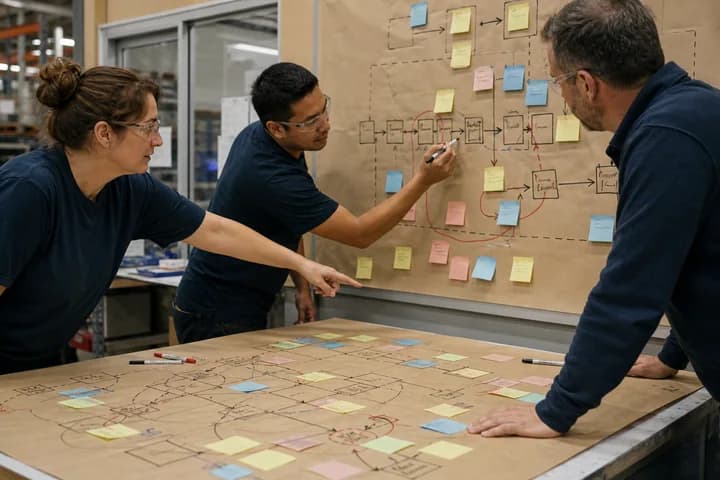
  3. A diverse team reviewing a decision flow during a facilitated workshop
    03

    Decisions

    Find the work worth improving

    Score real opportunities for value and feasibility, then set the controls that make the strongest candidates responsible to test.

    What this creates

    A governed shortlist of worthwhile opportunities

    Deliverables0405
  4. A leader reviewing an operational briefing and evidence at a desk
    04

    Action

    Turn insight into a pilot roadmap

    Leave with priority use cases, risk-aware next steps, system considerations, and a practical path to test, learn, and scale.

    What this creates

    An owned pilot roadmap with measures and next actions

    Deliverables0607

Why clients value the path

Real value, without a vague AI strategy deck.

  • Business-first instead of tech-first
  • Leadership and frontline input in one process
  • Value-versus-feasibility scoring built in
  • Clear next actions instead of vague strategy slides

Optional detail · open only what you need

What sits behind each checkpoint.

The pathway above is the big picture. Use these rows only when you want to inspect what goes in, what happens, what you receive, and how the result is evidenced.

  1. A facilitator and two organizational leaders reviewing readiness evidence together01AssessReadiness baselineOpen deliverable details

    We establish a clear starting point across people, leadership, workflows, data, risk, and change capacity before any tool or pilot decision is made.

    Client question

    Are we ready enough to move, and what would block adoption first?

    What we need

    • Leadership perspective
    • Current systems context
    • Existing AI use
    • Known risks

    What happens

    • Score practical readiness dimensions
    • Surface the weakest adoption constraint
    • Separate urgency from actual implementation capacity

    What you leave with

    • Readiness scorecard
    • Strengths and constraints
    • Recommended starting posture

    Evidence standard

    • Shared baseline
    • Named first constraint
    • Clear next conversation
  2. A cross-functional team discussing AI confidence and support needs in a facilitated session02AssessTeam AI literacy viewOpen deliverable details

    We capture how people understand, use, question, and govern AI in day-to-day work so enablement matches the team reality.

    Client question

    What do our people already know, where are they unsure, and what support would make AI safer to use?

    What we need

    • Participant responses
    • Role context
    • Tool familiarity
    • Open-text concerns

    What happens

    • Measure practical AI confidence
    • Identify support needs by theme
    • Find where informal use is already happening

    What you leave with

    • Team literacy summary
    • Capability gaps
    • Enablement themes

    Evidence standard

    • Completion view
    • Common concerns
    • Training priorities
  3. Frontline employees tracing handoffs and bottlenecks on a detailed workflow map03DiscoverWorkflow friction mapOpen deliverable details

    We map real workflows with the people closest to the work, then identify repeat effort, delays, handoffs, and data friction.

    Client question

    Where does work actually slow down, duplicate, stall, or require too much manual effort?

    What we need

    • High-friction workflows
    • Process owners
    • Step-by-step reality
    • System touchpoints

    What happens

    • Map the current-state workflow
    • Score friction and severity
    • Capture handoffs, delays, and manual work

    What you leave with

    • Workflow map
    • Enhancement opportunity inventory
    • Friction severity view

    Evidence standard

    • Mapped steps
    • Top bottlenecks
    • System dependencies
  4. A team comparing opportunity cards on a value and feasibility matrix04DiscoverPrioritized use-case backlogOpen deliverable details

    We convert process enhancement into candidate AI use cases, then score each idea for business value, feasibility, data sensitivity, complexity, ownership, and next decision.

    Client question

    Which AI opportunities are useful enough and realistic enough to consider first?

    What we need

    • Mapped workflow friction
    • Candidate ideas
    • Data availability
    • Owner perspective

    What happens

    • Describe the problem and AI opportunity
    • Score value and feasibility
    • Separate attractive ideas from implementable ones

    What you leave with

    • Prioritized backlog
    • Value-feasibility view
    • Implementation-ready candidates

    Evidence standard

    • Ranked ideas
    • Known data needs
    • Clear next decision
  5. An operations team reviewing data controls, approval points, and human oversight05PilotGovernance checklistOpen deliverable details

    We define the controls needed to move responsibly: data use, approval paths, human review, vendor or model risk, and escalation.

    Client question

    What guardrails need to exist before people trust or scale this?

    What we need

    • Risk profile
    • Sensitive data rules
    • Approval owners
    • Human review needs

    What happens

    • Capture responsible AI controls
    • Clarify approval and escalation paths
    • Document human-in-the-loop requirements

    What you leave with

    • Governance checklist
    • Approval notes
    • Risk recommendations

    Evidence standard

    • Named controls
    • Review points
    • Risk notes
  6. A project team assigning owners, measures, dependencies, and milestones on a pilot roadmap06PilotPilot roadmapOpen deliverable details

    We turn the strongest use cases into accountable pilot charters with owners, sponsors, hypotheses, success measures, systems, data, risk, effort, and timing.

    Client question

    What can we pilot first, who owns it, and how will we know whether it worked?

    What we need

    • Top use cases
    • Pilot owner
    • Success measure
    • Systems and data needs

    What happens

    • Create pilot charters
    • Define success and stop criteria
    • Sequence work by readiness and effort

    What you leave with

    • Pilot roadmap
    • Charters and owners
    • Success metrics

    Evidence standard

    • Accountable owner
    • Target outcome
    • Delivery status
  7. Organizational leaders using an implementation guide to agree on their next action07PilotImplementation guideOpen deliverable details

    We synthesize readiness, literacy, workflow friction, use cases, governance, and pilot planning into a practical guide leaders can act on.

    Client question

    What should we do next, what should we avoid, and what evidence supports the recommendation?

    What we need

    • Assessment data
    • Workflow maps
    • Use-case backlog
    • Governance notes

    What happens

    • Synthesize evidence across the engagement
    • Translate findings into recommendations
    • Create a practical next-step guide

    What you leave with

    • Implementation guide
    • Recommended next moves
    • Evidence-backed roadmap

    Evidence standard

    • Traceable evidence
    • Clear recommendations
    • Pilot-ready summary

The takeaway

Leave with a shared, pilot-ready game plan.

Instead of “we should do something with AI,” your team has a shared view of where the best opportunities live, what has to change, and what should happen next.

  • Readiness baseline
  • Shortlist of use cases
  • Workflow friction map
  • Priority pilot roadmap